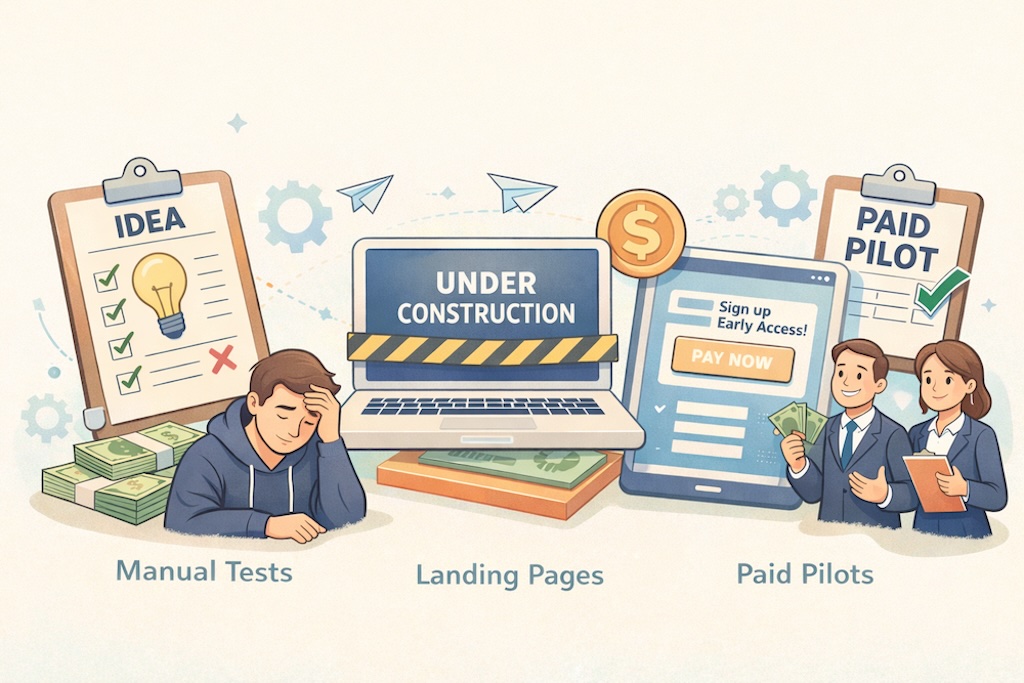
Manual workflows, landing pages, and paid pilots that actually work
If you’ve been around MicroSaaS long enough, you’ve seen this movie.
Founder gets an idea.
Spends 2–3 months building.
Launches on Product Hunt or Twitter.
Crickets.
Eventually says, “Marketing is hard.”
Most of the time, the problem isn’t marketing.
It’s that the idea was never validated in the first place.
Validation doesn’t mean likes, upvotes, or “this is cool” comments.
Validation means someone who has the problem is willing to give you money or commit real time — before the product exists.
The good news: you don’t need to write code to get that signal.
This is how founders who actually ship and survive validate MicroSaaS ideas before building.
First, let’s clear something up: interest ≠ intent
A waitlist with 200 emails feels great.
It also means almost nothing by itself.
Founders consistently overestimate demand because they test ideas inside friendly circles:
- Twitter followers
- Indie hacker communities
- Friends who “love startups”
Those people are biased. Real users aren’t.
The goal of validation is not attention.
It’s proof of pain.
Pain shows up as:
- Willingness to pay
- Willingness to share data
- Willingness to change behavior
- Willingness to commit time
Everything below is designed to test that.
Method 1: Manual workflows (aka the “just do it by hand” approach)
This is the most underrated move in MicroSaaS.
Instead of building software, you manually deliver the outcome your product promises.
No automation.
No dashboards.
Just results.
What this looks like in practice
Let’s say your idea is:
“A tool that cleans up messy CRM data for small sales teams.”
You don’t build the tool.
You:
- Ask 5–10 sales teams for access to their CRM export
- Clean the data manually (scripts, spreadsheets, VAs, whatever works)
- Deliver a clean version within 24–48 hours
- Charge for it
Congrats. You’re validating.
Why this works
- You learn exactly what users care about
- You see how painful the problem really is
- Users tell you what they’d pay to automate
- Your “manual steps” become your future product spec
A shocking number of successful MicroSaaS products started this way — quietly, manually, and unsexy.
What to watch for
Strong signals:
- Users keep coming back
- They ask “can this be faster?”
- They ask for integrations
- They complain when you’re slow (good sign)
Weak signals:
- “This is nice, but not urgent”
- One-time use with no follow-up
- They ghost when you mention pricing
If people won’t pay a human to solve it, they won’t pay software either.
Method 2: Landing pages that actually test something
Most landing pages are designed to look good.
Validation landing pages are designed to force a decision.
What a real validation landing page includes
- A specific problem (not vague productivity talk)
- A clear outcome
- A price (or at least a price range)
- A call to action that requires effort
Good CTAs:
- “Book a 15-minute call”
- “Pay $49 for early access”
- “Apply for beta”
Bad CTAs:
- “Join the waitlist”
- “Notify me”
- “Coming soon”
If your CTA doesn’t cost time or money, it’s weak validation.
Don’t keep the waitlist inside your bubble
Here’s where a lot of founders mess up.
They build a landing page.
Share it on Twitter.
Friends sign up.
They feel validated.
They’re not.
Real validation happens when strangers respond.
One smart move is treating the waitlist itself like a small product launch and putting it in front of people who don’t know you.
For example, publishing a focused launch page on a curated discovery platform like Pitchwall allows founders to test interest from a cold but relevant audience during a product launch — before committing to building anything.
This does a few important things:
- Tests if the problem is understandable without context
- Filters out “supportive founders” from real buyers
- Surfaces real objections early
- Shows whether the positioning works outside your network
If strangers are willing to click, read, and take action — that’s a real signal.
If they don’t, you just saved months of work.
Method 3: Paid pilots (the strongest signal you can get)
If you’re building B2B MicroSaaS, this is the gold standard.
A paid pilot means:
- Limited scope
- Limited time
- Clear outcome
- Money up front
Not free.
Not “let’s see how it goes.”
Paid.
Why paid pilots work
- They force honesty on both sides
- Customers pay attention when they pay
- You immediately learn what “success” means to them
- Conversion to full pricing becomes obvious
Even a small payment counts.
$100 > 1,000 waitlist emails.
How to price a pilot
Simple rules:
- Charge 1–2 months of expected subscription price
- Or 20–30% of annual price for a 60–90 day pilot
- Keep scope tight
You’re not selling the full product.
You’re selling proof.
What to measure (and what to ignore)
Ignore:
- Twitter engagement
- Upvotes
- “Love this idea” comments
- Vanity traffic
Measure:
- Time to first value
- Repeat usage (even manually)
- Willingness to pay again
- Objections that come up repeatedly
- What users ask you to automate first
If users are pulling the product out of you, you’re onto something.
A simple 14-day validation sprint
If you want something concrete, run this:
Day 1–2
Define one painful problem and one outcome.
Day 3–4
Create a basic landing page with pricing and a strong CTA.
Day 5–7
Share it outside your network (communities, cold outreach, curated platforms).
Day 8–12
Manually deliver the solution to anyone who bites.
Day 13–14
Ask for payment or a paid pilot.
Decision time:
- If people pay → build the smallest thing that automates the pain
- If people hesitate → fix positioning or niche
- If no one bites → move on
That’s not failure. That’s discipline.
Common mistakes that kill good ideas early
- Building before charging
If you’re scared to ask for money, that’s your answer. - Validating with other founders only
Founders are not your customers (most of the time). - Optimizing too early
Validation is messy. Don’t polish experiments. - Confusing distribution with validation
Validation proves the problem exists. Distribution is a separate battle.
Final thought
MicroSaaS isn’t about clever ideas.
It’s about boring problems that hurt enough for people to pay.
The fastest founders aren’t the best builders.
They’re the ones who learn before they build.
Manual work, uncomfortable asks, and early money beat months of silent coding — every time.
If you’re not a little uncomfortable during validation, you’re probably doing it wrong.